
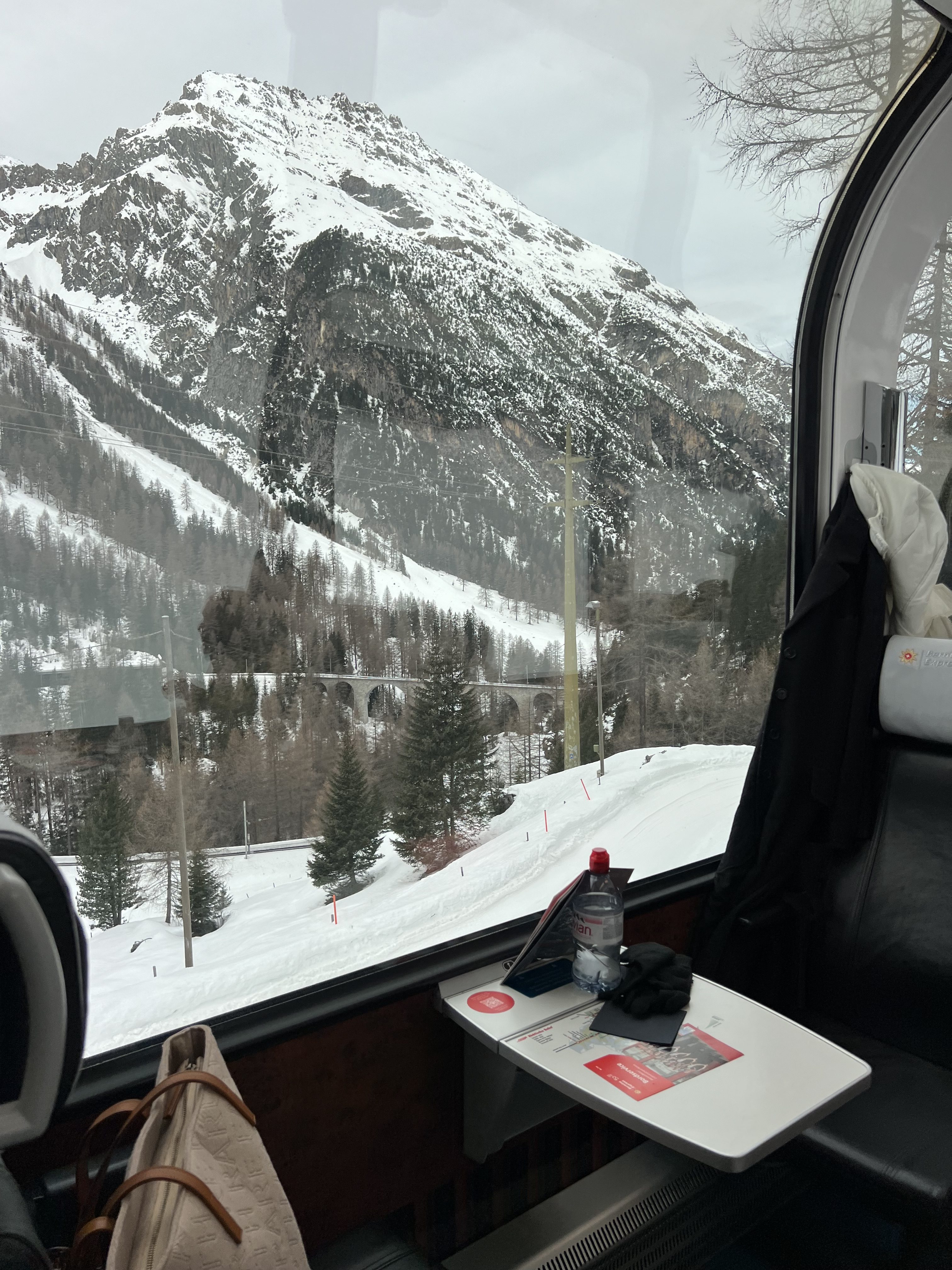
Known as one of the world’s most beautiful railway routes, the Bernina Express has become a bucket-list experience for many. Showcasing divine natural beauty, coupled with man’s incredible design, the 4-hour journey passes through the snow-capped Swiss Alps right through to the quaint towns of northern Italy. The UNESCO World Heritage Site provides a scenic opportunity to travel between north and south Europe, with convenience and ease of a direct route, and the pleasure of space and panoramic windows.
Here are some logistical tips and tricks for embarking on this route, with an overall recommendation and itinerary suggestion below:
Train route and stops
4 hour journey through the Alps, from Switzerland to Italy’s northern border
As the highest railway tracks in Europe and the steepest in the world, the Bernina Express passes through 55 tunnels and over 196 bridges in 4 hours. Linking the southern Swiss towns of Chur and St Moritz, through to the northern Italian border in Tirano, there are multiple impressive and noteworthy ‘sites’ but arguably, the entire journey is a beautiful and breath-taking one.
The Bernina Express only makes one stop that allows passengers to climb off: for 20min, you are able to enjoy the viewpoint of Alp Grüm, overlooking the lake and snowcapped peaks. For more ‘hop-on hop-off’ flexibility, consider taking the regional trains.
Bernina Express Timetable
In winter, there is one daily train each way (to maximise daylight, travel from Chur to Tirano):
- Chur to Tirano: departure at 08:28am, arriving at 12:49pm
- Tirano to Chur: departure 14:24, arriving at 18:22
In summer, there is an additional route each way:
- Chur to Tirano: departure at 13:34, arriving 17:59
- Tirano to Chur: departure at 08:06am, arriving at 12:22pm
Tickets
Secure a train ticket or travel pass, as well as a seat reservation (up to 3 months before your train).
For the Bernina Express, passengers need to purchase a ticket, and reserve a seat. If you are travelling through Switzerland, or through multiple countries, consider getting the Swiss Travel Pass or the Eurail Pass: both should cover the Bernina Express, allowing you to ride in the class specified on your pass. However, in addition to the pass, you’ll need to purchase a separate seat reservation for the Bernina Express.
However, for those that are have a shorter stay, and would like to experience the allure of the Bernina Express, see the latest Rhaetian Railway rates and T&Cs below:

For a more affordable option, consider taking the regional trains through the same routes. This allows you to climb off at whichever stops you like, and open the carriage windows (which is great for photographs). However, this is not a direct route – travel light to minimise lugging bags between stops.
Photography tips
The Bernina Express is known for its iconic panoramic windows, which are one of the luxuries of travelling onboard. However, for a photographer, it’s worth noting that the windows don’t open and the glass can cause a glare.
That being said, there are small windows that open on some of the connectors between carriages. While you don’t need to ‘reserve’ these connector spots, it’s ideal to have your seats closer to the connectors to get those ‘moments’.
Depending on the direction of your route, and if you are travelling as a group or couple, in first or second class, there are a number of ‘ideal’ seats. For first class, from Chur to Tirano, the green seats below on carriage no. 12 were closest to the opening windows (and furthest from the luggage, adjacent to seats 13-14).

Luggage
Most travel blogs say that the Bernina Express offers more space for luggage, than the regional trains. While that may be true, the Bernina Express doesn’t have that much space for all passengers’ bags. Ensure to board the train early to secure a spot for your luggage.
Onboard hospitality and service
While panoramic trains like the Glacier Express include dining, the Bernina Express does not include food, but does offer a snack and drink service. The snack options include local beef ‘salsiz’ (CHF 29) and cheeses (CHF 22), as well as traditional walnut cake (CHF 4.50) and pear bread (CHF 7.50) – not very conventional for the fussy eaters and kids. You can also enjoy some cold drinks and coffees, and select wines and a local beer. There is also a ‘souvenir shop’ onboard.
Irrespective, eating onboard is permitted and packing snacks* is recommended.
*if you are staying in Chur, remember the early shop closing hours / consider the stores in the train station (generally open till later).
Overall recommendation
- One-Way vs. Return: For those that would like to experience the Bernina Express, I would suggest travelling one-way, and integrating it as part of your travel itinerary. Alternatively, if this is a day trip, it would be worth traveling with the Bernina Express on-way, and using the regional trains for the return – both from a budget perspective, and for the difference in experience.
- First vs. Second Class: the difference comes down to space, but seems to be minimal. However, if you would prefer a bit more privacy, or travelling with one other person, First Class offers 2 seats, facing each other, against the windows (as well as groups of 4, 2 pairs facing each other, like in Second Class).
- Direction of Route: due to limited winter day-light, the north-to-south route offers a bit more visibility as the journey starts and ends in the day. However, depending on your itinerary, starting in Tirano and ending in Switzerland shouldn’t cause too much difference.
- Chur vs. St Mortiz: as mentioned above, the route linked to Chur is a bit longer, allowing for more opportunity to see the beauty of the Alps. However, should you have more time t enjoy winter sports, St Mortiz is renowned for its skiing and slopes, allowing you to experience the beauty of Swiss winter from another perspective.
TRAVEL ITINERARY:
Depending how much time you have, and which season you’re adventuring in, there are a few wonderful destinations to add onto the Bernina Express route.
While you can extend the stops throughout the south of Italy, or reverse the journey to travel ‘upwards’, this is the path I would recommend for a 10-15 day trip, especially in winter:
Start in ZURICH
For snowcapped Alps and wintery cityscapes: start your journey in Zurich, Switzerland. After a couple of nights in the landlocked Lindt city, venture southward to one of the 2 Swiss starting points of the Bernina Express: St Moritz or Chur.
Take the Bernina Express from CHUR or ST MORITZ
We opted for the latter as the Bernina Express route from Chur would be slightly longer and, hence, more scenic. However, if you have time to ski, St Moritz is a beautiful place to adventure through and offers renowned resorts. While Chur also has its own local slopes and cable ways, St Moritz is more suitable for the winter sports fanatics. Should you find yourself in Switzerland’s oldest town, Chur (in my humble opinion) it is great for one night, and no more.
Once you conquer your time in Chur, enjoy an unforgettable 4 hour journey to Tirano in the north of Italy with the Bernina Express. Explore the town of Tirano for the day, or hop onto the regional train and head southward for a more popular destination to explore:
Pass through LAKE COMO (in summer)
For those visiting in summer, you can extend your trip with a stop in Lake Como – home to some of the world’s oldest and most opulent villas. In summer, there are buses from Tirano to Lake Como, but the trains seem to be more comfortable and run year-round, continuing to Milano thereafter. For a more in-depth guide on Lake Como, click here.
Explore MILANO
Alternatively, head straight from Tirano into Milano. Irrespective of season, the city buzzes with life and culture, and is an incredible place to indulge in arts and gastronomy. Explore more of Italy’s fashion capital here.
Time for a detour? Visit BOLOGNA
Should your itinerary allow, I would recommend lengthening your journey through the Emilia-Romagna region and visiting Bologna for a night or two. La Rosa, as nicknamed by the locals, is known for its gastronomy scene, quirky nightlife and medieval influences.
Conclude in VENICE
Since our journey was in the first weekend of February, and coincided with the infamous Carnevale, our trip included, and concluded in, Venice. The floating city is popular year-round and attracts hoards of tourists, despite its perceived loss of authenticity, its essence and history is still impressive, and worth exploring. That being said, if travelling this route through winter, consider visiting over a festive period (like before Christmas, or during Carnevale) to add some warmth and tradition to the otherwise rainy maze. Click here for a Venice travel guide.
Leave a Reply