
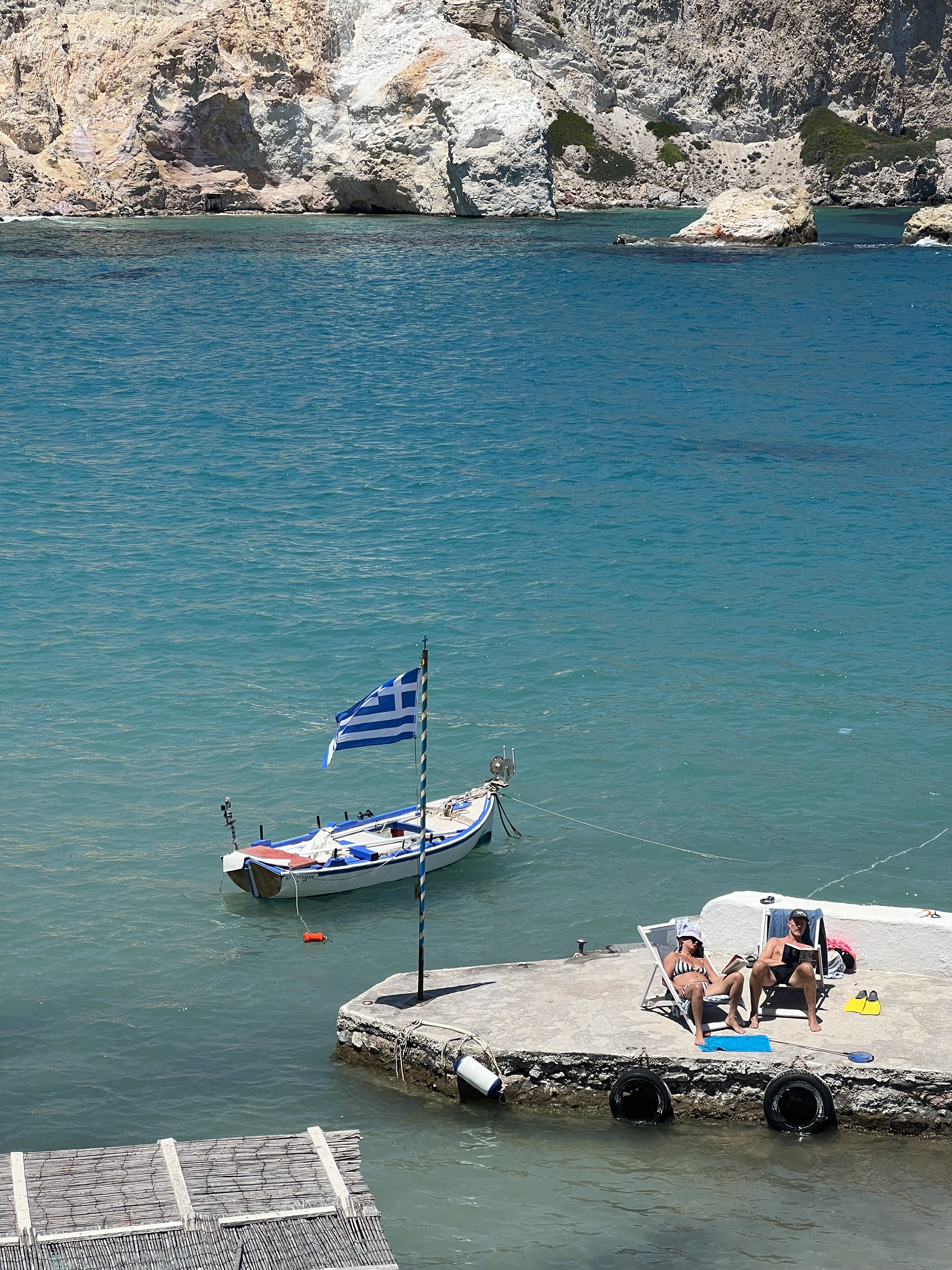
From ordering coffee and quad rentals, to shopping times and island stereotypes. Here’s to exploring this Mediterranean oasis:
THE BASICS
Language: Greek (a ‘romantic language’ with its own alphabet)
Religion: predominantly Greek Orthodox (Christian)
Currency: Euro € (and member of the European Union)
Season: July and August are the most popular months, as well as the hottest. From experience, visiting Greece from middle of June until the end of September (on the summer ‘periphery’) is arguably nicer – it’s less busy and a more moderate heat.
Driving: right-hand side of the road
Affordability: while there are luxury options for the most part of Greece, the day-to-day is relatively affordable (versus the rest of Europe). As an example, water is regulated to be €0.50 per 500ml, and cannot be irregularly inflated, as seen in Italy or Switzerland. Likewise, greek street food is quite cheap too – a gyro is typically priced around €3, and coffees are around €2.
FOOD & FLAVOURS
Greek coffee (elliniko cafe)


If an Italian espresso and Arabic coffee had a love child, it would be elliniko cafe. Greek coffee is strong and served with grounds in the cup. A good cup of ‘elliniko cafe’ has kaïmaki (a layer of foam on top) and each person has their ‘trick’ to get this right.
To order specify:
Size:
Mono – single
Diplo – double
Sweetness:
Sketo – no sugar
O’ligi – with a little bit of sugar
Metrio – equal coffee to sugar (the ‘norm’)
Glyko – sweet
Some tourist traps chuck the coffee grinds into already boiled water – this is not correct and doesn’t allow the coffee to boil – ie. avoid this.
Iced coffee (frappé and Freddo)
The original ‘delgano’. Frappé is Greek iced coffee made with instant coffee, ice, water, and optional sugar and milk. There is also the famous ‘Freddo Espresso’ and ‘Freddo Cappuccino’ (like an iced latte). Either way: a great way to cool off on the beach.
To order, specify sweetness (like for greek coffee), and:
Milk:
Meh gala – with milk
Mavro / horis gala – without milk
Salads (Xoritatiki vs. Elliniki)

The Mediterranean is blessed with some of the most incredible produce – the summer and autumn months being the most fruitful! But once of the best ways to taste this is by ordering a salad for the table when you dine out. There are two main ones with a small distinction: Horiatiki (village) salad contains tomatoes, cucumber, onion, olives, feta cheese and oregano. Elliniki (greek) salad, add lettuce to the above.
Bakery (Zaxaroplastio)
Greece is full of bakeries, all with delicious pastries and pies (‘pites’) to try. From the savoury spanakopites and tiropites, to the sweet galatoboureka and amigthalota, there’s no shortage of choice (unless you’re gluten intolerant, bless…). For those that can, ask what the island or area’s local pastry is and give it a try – their specialty is based on fresh local produce, as well as years of perfecting recipes.
EXPLORING
Greece has over 220 islands and, for those that don’t want to visit the classic tourist magnets, it can be overwhelming to choose.
For ease of reference:

🔴 Cycladic islands are great for island hopping and are fairly close to the Athens ports. But they are well visited, and tend to be drier and windy than the others. These islands are good to explore on a bike, or use the public buses.
🟣 Saronic islands are also close to Athens but a little less explored by foreigners, and more frequented by Greeks. Some are ‘no car’ islands, so quadbikes and water taxis are best to move around.
🟡 Dodecanese are closest to Turkey and, from Greece, are more conveniently accessed by plane, than ferry. These islands are well known for their history and cultural monuments especially.
🔵 Sporades are the ‘mamma mia’ islands – green landscapes with blue waters – a beautiful combination. I’d recommend getting a quad or car.
🟢 Ionian islands are my personal favourite; bright blue waters and white stones, all nestled in green mountains. They tend to be bigger too (best to hire a car), and given their neighbouring coast, some have Italian influences.
🟠 North Aegean – I am yet to explore this part. But! I hear that they have their own beauty and unique culture, dialect included. Crete, in a category of its own, is a massive island to explore and deserves its own time to discover.
Island hopping
View the sea routes through FerryHopper or FerryScanner – it shows the direct routes from each port and different lines. Athens has a number of ports but Piraeus is the most popular. Also, if you have rented a car and have opted to drive to port, you can take vehicles on select ferries, at an additional fare.
If you would prefer to fly, a number of the islands do have airports, and you can take smaller boats (pantofles, meaning slippers) between the islands once you’re there.
Island exploring
Depending on the size of the island, and your budget, I would recommend renting a quad-bike. For the Cycladic islands, it’s normally quite cost effective, offers the freedom to roam alone while also not wasting too much time looking for parking (often scarce). For the more touristy and popular islands, be sure to have an international drivers with you (especially Milos).
ALSO: taking a boat around just about any island, and discovering some of the untouched (and inaccessible by land) beaches, is one of the most incredible experiences – I couldn’t recommend it more. Depending on where you are, there are different types of tours (private, groups, rentals etc) but I think it’s something to try budget for both financially and in terms of days/activities.
Mainland exploring
In Athens, you can use the tram, buses or trains – all are efficient and clean. Or, you can call a taxi (more recently: uber) but the fare will obviously be more.
Monuments
Greeks joke about inventing everything, and in any given view you’ll be able to spot the country’s flag – it’s patriotic to say the least. BUT, rightfully so, there is so much history, and even the small remote islands have some kind of ruins and mythology attached to it. Whether you want to hit every monument and its museum, or just visit the ‘IG worthy’ ones, take a moment to appreciate how old and incredible the man-made creations are. General tips:
* it can get hot in the outside ruins, so head up early, or on a cooler day – stay hydrated.
* there are normally different prices for students/pensioners/EU citizens so be sure to ask before you tap that card.
* @talia_marshall recommended Rick Steve’s audio guides on Apple Podcasts / Spotify for extra guidance when exploring.
Churches and customs
The predominant faith here is Greek Orthodoxy – and similar to other Christian churches, when entering it’s advised to be in appropriate clothing (no hats, covered shoulders etc.). Entrance is free and open to anyone, with various donation spots around the church – like when lighting a candle in the entrance. Many of the islands and areas have a ‘patron saint’ – one that the town holds in high regard due to their history and miracles. As such, many believers do pilgrimages to specific churches or monasteries with the faith that the journey and prayers will heal the sick, or find resolve, for themselves or someone they care about. Also to note, when passing a church, many Greeks will do a cross, 3 times, with their right hand.
Shopping
If you’re wanting to capitalise on the european end of season sales, be sure to check the respective town’s shopping hours (it’s not a ‘9-5’ standard) to account for siesta hours and off days. ALSO, if you make a retail purchase over €50, you can ask for a Tax back slip (ask before you swipe) so that you can claim back at the airport.
Closing hours (siesta)
While it’s not as common in the mainland cities, many of the smaller islands still honour siesta and close stores between 14:30-17:30. In Syros, we always made sure to do a coffee/snack run before 14:00 so we would last until the late summer dinner.
Kiosk (periptero)
The periptero – the iconic Greek kiosks that sell anything from tobacco and phone cards, to newspapers and ice creams. You’ll find these small stalls across the whole of Greece and carry a sense of nostalgia of many childhood lollies as summer stops for something sweet. The photo below is a mobile and mini version found on some of the beaches.
Connectivity and sim cards
There is wifi in most cafes, and many beaches, but for those working remotely, or wanting continuous connection, Vodafone normally has a summer special: this year’s was €45 for unlimited data and some minutes for European calls (a real game changer vs. SA’s expensive data) and €35 for 20GB over 20 days (something like that). You can organize a sim before you even collect your luggage at the airport, or at the arrivals outside. If you would like to keep your home sim, consider looking at an e-sim (not currently offered by Vodafone here).
Leave a Reply